
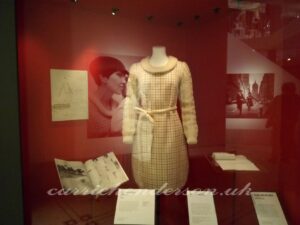
“There she is!” says a woman entering the Mary Quant exhibit, pointing out a large black and white photo of the designer to her friend. Tucked behind the V&A’s costume collection, they’ve patiently queued for the moment they can enter and I feel the same excitement, anticipating a colourful run-through of her fashions between 1955 and 1975.
Mary Quant is so iconic she needs no introduction. Her cropped Sassoon bob and Daisy logo have sunk into our consciousness to such an extent, it seems impossible that there was a time when the influence of her designs was not felt. The exhibition focuses on the golden years, the years of the Ginger Group, Puritan Fashions and ‘The London Look,’ but there’s a surprise in store. Using hashtag #wewantquant the V&A is asking for your Quant outfits, a democratic gesture reflecting ordinary people’s outfits and the stories that went with them as well.
Quant would like that; her success represented a change of culture from the ground up. At a time when the industry was dominated by a top-down system of couturier to high street, she bucked it, carving out a method of making and selling that captured the imagination of girls swooning over Elvis, refusing to wear ‘Mother’s Tweeds’ one moment more.
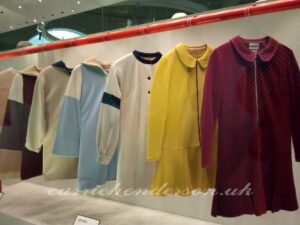
Folklore like this is covered but the exhibition’s more than repetition or a memory-jog. Bursts of colour and individual outfits grab your eye but there are muted tones and fabrics; expert design and tailoring. Outfits like “Bank of England” a waistless shift dress with a huge puritan-style collar, shocking British Vogue in 1962, are expected, but it is immersive and interactive; beyond the cabinets and clothes.
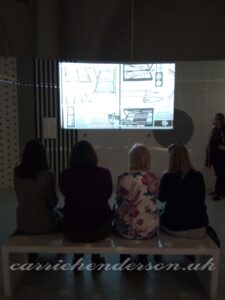
After 1954 when “London was a bombsite,” Quant’s sweeping invasion is depicted with a black and white film so large you stand with the camera witnessing the culture clash on a rainy Kings Road. Older ladies carrying umbrellas in their 1950s swing coats walk past mini-dresses in their window and you can see why it caused such a stir.
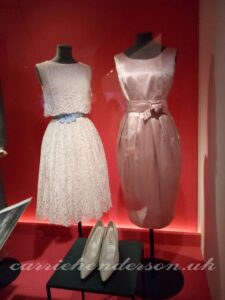
“Fashion must be created from the start for mass production with full knowledge of mass production methods.” Quant’s confident voice echoes in clips of interviews projected onto film.
The philosophy behind her decision-making doesn’t seem that ground breaking to those of us living with fast fashion, but it was back then. To the establishment she was unthinkable but to the ‘Young Set’ she was a goddess, and the same women 50 years later with greying hair and skinny jeans, follow her round.
Ruefully, one woman says, “Back in the 1990s I bought one and I got rid of it. It was out of fashion. It was green.”
Another says to the friend at her right, “I wore dresses like that when I was pregnant.”
Someone traces the line of one of her Workwear garments as if drawing the pattern pieces with her finger in the air, from collar to hem; “I always associate her with straight skirts,” she says intently, finishing the outline.
“You have to have the shape,” replies her friend with certainty. Each outfit makes you question how they would look on a woman who was not tall, slender and with small boobs; the ladies had to have the right silhouette and they know it.
A singular voice of dissent moans to the crowd when a fashion student says to his teacher, “But it’s sooooo dated!” Disappointed and with an impatient note in his voice, she doesn’t blink as she looks at the same dress in a reverential silence, lost in thought. When she doesn’t answer her student walks off, leaving her standing alone.
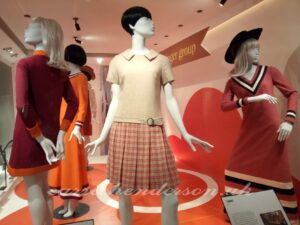
One of fashion’s greatest controversies is part of the folklore; did she invent the mini-skirt or was it Parisian Courrèges? We discover Quant’s simplistic rationale holds the truth. She saw young girls taking up hems and did it too, but it there might be another scandal; did she invent the Maxi dress as well?
A case stuffed with reds and oranges brighter than the sun has a dress called Sardines, made before maxi’s became popular. We walk away thinking, “can we attribute this to her too?”
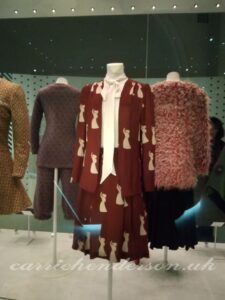
Finishing with a finale of licensing and Daisy Dolls, her partnership with pattern maker Butterick, shows the way girls could afford her designs by making them at home. The Seventies are not as well represented and the Fifties also. It is the Sixties that stands out from this collection and the typed memories hanging from the ceiling from those who wore them also.
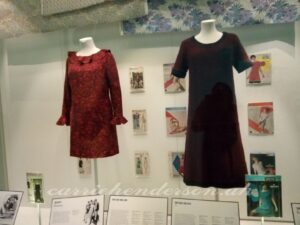
The V&A says the Sixties revolution was as much down to Quant as the pill, the Beatles and the Stones. The entire exhibit is exciting, fresh and fun, a twenty-year story well told, shouting that if you remember Quant then you were there and never had it so good!
Copyright 2020 Carrie Henderson. All Rights Reserved.